The spreading of electricity in Denmark
From 1910-1920 there is a significant upturn in the number of power stations, but electricity is only slowly spreading into Danish homes. The first installations in Danish homes are often limited to a single lightbulb in the ceiling, and the only power socket in the home is usually placed in the kitchen to energise the electric iron. You are able to lease an electric iron for 0.50 Danish kroner per quarter.
But electricity is expensive compared to the buying power of the time. In 1918, one kilowatt-hour costs 1.18 Danish kroner, and the standard hourly wage is 0.50 Danish kroner. So light is economised on. A lot of people think that electricity is for the industry – and not for luxuries like irons and reading lights.
Chapter 2: 1919 - 1925
Nordisk Solar Compagni
Financially strong and visionary businessmen establish a new company in Kolding
On 16 May 1919, Jacob Jørgensen, manager and owner of Solar Elektricitetsmaaleren, sells the Solar metre shop and its production facilities at Rendebanen to Kolding Elektricitetsværk. The 28-year old enterprising businessman is going to reinvest his newly acquired capital in his future and will not rest on his laurels. The next day, he establishes Nordisk Solar Compagni in Kolding together with his friend and peer, merchant Herluf Sørensen.
Even though until now, Jacob Jørgensen has primarily been selling electrical metres, he has no doubt that the demand for other electrical materials will grow fast, and that the customers, in addition to the well-known power stations, will be an increasing number of wind electricians, contractors and the like.
The past 7 years have taught him that the ability to procure, stock and deliver goods at the right time is the key to a successful business. Also, the war and post-war year with its scarcities and import and currency restrictions have also taught him the importance of being far-sighted and adapting quickly, when goods are to be provided either via procurement or own manufacturing.
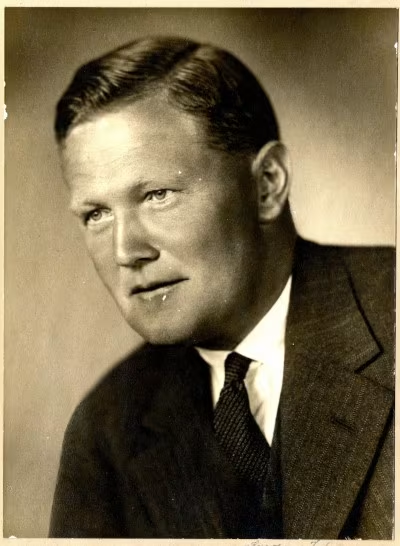
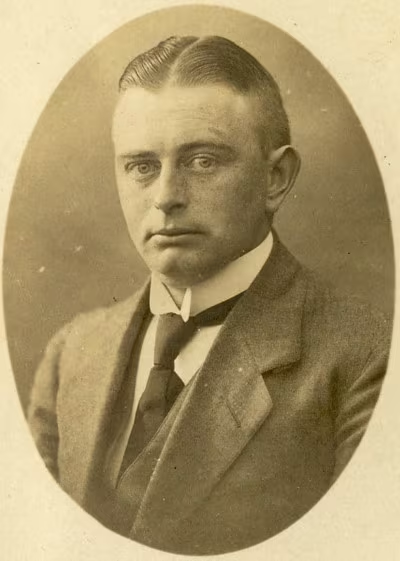
Jacob Jørgensen is not in doubt about his role. He continually wants to run a business and invest in becoming a significant value-creating player in the changeable electrical trade. He is aware that it will require more operational and working capital to accommodate the wider group of customers with a wider assortment of products, and he is determined to find a financial partner. He easily convinces his friend Herluf Sørensen about the potential, and the two young businessmen agree to both invest in and establish the general partnership Nordisk Solar Compagni. The business foundation is partly selling electrical metres to the rapidly increasing number of power and utility stations – including replacing old direct current metres with new alternating current metres, meaning that power can be transported cheaper and over longer distances – and partly wholesale of electrical installation and consumption materials for the many private homes, where electricity will be laid on in the years to come. The two peers and partners know each other well from the business network Kolding Fodsportsforening af 1915. The chemistry between them is good. They each have the background and competences needed to form a partnership that will last for more than 25 years. Herluf Sørensen is a trained merchant and financially strong after receiving a family inheritance. In relation to the deed of foundation, the two prepare a clear owner’s agreement and division of labour. Jacob Jørgensen is in charge of technical tasks, sales and day-to-day management, while Herluf Sørensen handles the bookkeeping until the company gets on its feet. After the establishment, Jacob Jørgensen, Herluf Sørensen and a few employees move to Jernbanegade 19 in Kolding. Space is limited, as liquidity and costs must be kept down, as the company’s product range is to be continuously extended and adjusted to fit the constantly increasing demand.
Busy establishment years on the crest of the waves
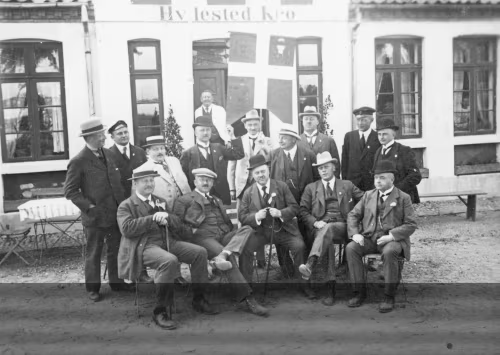
The need for electricity booms and new utility plants sprout everywhere. In 1919, the municipality of Kolding initiates renewal and improvement of the electricity network, which is to be carried out during the course of two years. As the association of power stations in south-eastern Jutland, who built the station in Harte, is already making use of Solar’s expertise, the start-up is a busy time. The timing of Jørgensen and Sørensen’s establishment of Nordisk Solar Compagni is well-chosen and confirms their vision and understanding of the significance of the technological breakthrough. Nordisk Solar Compagni achieves a revenue of 320,000 Danish kroner in the first year and presents a solid profit. Already in 1920, more employees join the company, including a bookkeeper, as Herluf Sørensen wishes to withdraw from the daily operations. In the meantime, Jacob Jørgensen receives trade licenses both as merchant and as manufacturer. Herluf Sørensen continues as partner and later on as board member in Nordisk Solar Compagni.
Move and change
After almost four years, in the spring of 1923, Nordisk Solar Compagni is doing so well that Jacob Jørgensen can rent the ground and first floor of one of the biggest and best placed buildings in the city, “Borgen” (the Castle) at Haderslevgade 21-23 (which later becomes Haderslevvej 25) in Kolding. Solar has grown out of the limited space in Jernbanegade, and the move is necessary for the continued growth of the company. The last year, Jacob Jørgensen has had to rent storage space several places in the city. With the new lease, everything is gathered in one place and made more efficient, and work becomes less difficult as the modern building is quite revolutionarily equipped with an outside freight lift. The sales of electrical materials to contractors in Kolding and the surrounding area boom, and at the same time, the company receives several requests from more remote customers. Jacob Jørgensen knows that the market potential is significantly bigger. He therefore asks the company’s attorney N.C. Jehrbo to become a travelling salesman. N.C. Jehrbo is to visit contractors in all of Jutland and grow the business with.
Close to one and a half year after moving into “Borgen”, Jacob Jørgensen changes the focus from Nordisk Solar Compagni’s business foundation significantly. He separates the metre shop including its business activities and 13 employees into the company Dansk Målerværksted. The company’s loyal foreman, who has followed Jacob Jørgensen since 1914, becomes day-to-day manager and co-owner.
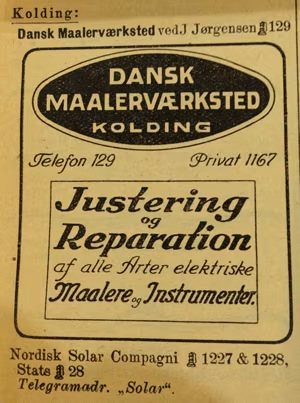
With the separation, Jacob Jørgensen directs Nordisk Solar Compagni’s business focus towards nationwide wholesale of electrical products, but at the same time, he considers establishing substantial manufacturing. A new and epochal era is coming.
CV - Jacob Jørgensen, Kolding 1925
Personal data
Name Jacob Lauritz Jørgensen Date of birth Born 17 January 1891 Place of birth Sønderborg, which at the time belonged under Germany Civil status Married in 1918 to Marie Andersen, Vamdrup Children Harald Preben Jørgensen (06.01.1918) and Edith Jørgensen (20.01.1920) Address The family lives at Strandvejen 9 in Kolding
Education and professional experience
1905 – 1906 Ship’s boy at the German school ship Potosi 1906 – 1909 Trains to be a ship constructing architect at shipyards in Flensburg and Eutin, Germany 1909 – 1910 Employed with Blom & Vos, Hamburg, and a power station in Hamburg 1910 – 1912 Employed as a sales representative and metrology expert with Solar Zähler Werke, Hamburg 01.02.1912 Immigrates to Denmark and represents the English company Solar Works 21.07.1913 Founder and manager of Solar Elektricitetsmaaleren v/ Pedersen & Jørgensen 12.06.1918 Is accepted as a member of a business network called Kolding Fodsportsforening af 1915 and is thereby recognised by the leading business network in Kolding. 16.05.1919 Sells the metre factory including equipment to the power station Kolding Elektricitetsværk 17.05.1919 Founder and day-to-day manager of Nordisk Solar Compagni, Jernbanegade 19, Kolding 12.12.1919 Receives trade license as merchant in Kolding 17.08.1920 Receives trade license as manufacturer in Kolding 01.04.1923 Moves the company to Borgen, Haderslevgade 21-23 (which later becomes Haderslevvej 25), Kolding 20.05.1924 Buys the house at Strandvejen 9 i Kolding 01.12.1924 Establishes the company Dansk Målerværksted, Kolding
Personal interests and qualifications 1925
Interests Family, horses and riding, ships and yachting Languages Masters Danish (with an accent), German and English in writing and speech Merchant Has a distinct sense for great business acumen, is innovative and an initiator Ambition ”I want to make my first million before I’m 30”
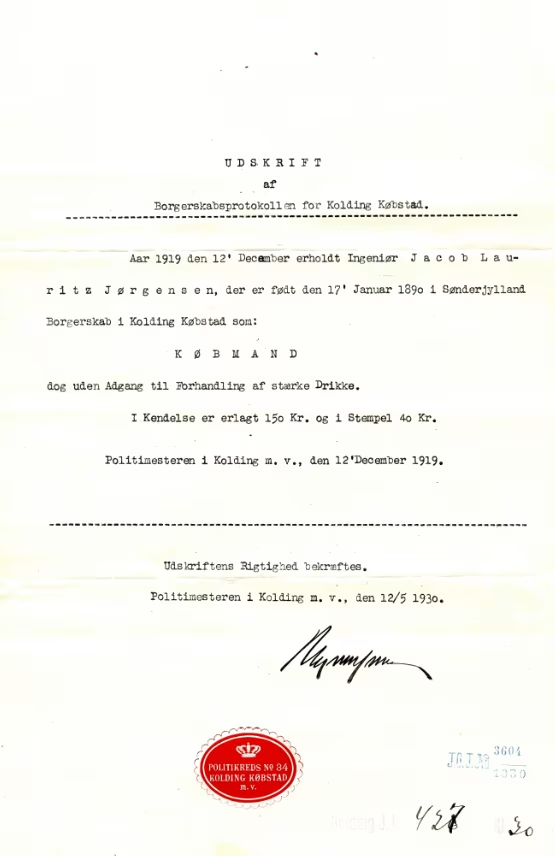
Merchant trade license, 12 December 1919
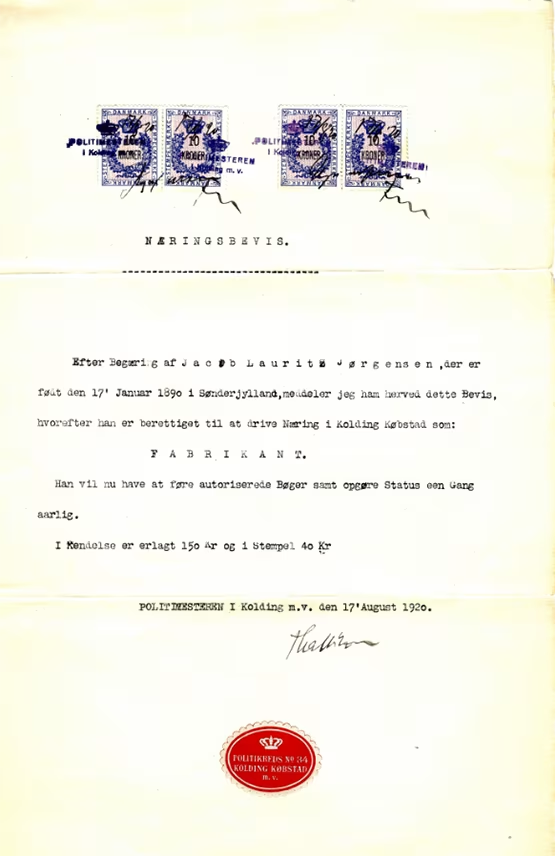
Manufacturer trade license, 17 August 1920