Chapter 6: 1949 - 1998
Light for the entire kingdom
Audiola convert to development and production of electrical equipment and lighting
After more than 30 years of radio production, Audiola decides to phase out their production of radios and gramophones. The company shuts down the production in the 50s and is determined to adjust their business area to development and production of electrical equipment and lighting. A/S Audiola Radio change their name to the production company A/S Audiola. As an important part of the strategy, Audiola moves their production to the more modern facilities in The Factory Yard in 1961. The transformation that started years earlier gets up to speed and a new era begins.
In his position as Chairman of the Board of Audiola, Jacob Jørgensen dictates no funny business. The strategy and guidelines are announced clearly and not to be mistaken. Audiola must be innovative and value-adding within their field. The company must also keep abreast of the use of the newest production technologies and have a close-to-market organisation which should enable them to foresee the needs of the market, both at home in Denmark, but also in the many export markets.
In just a few years, it’s no longer just bakelite presses that all lined up in Audiola’s factory floors. New raw materials and production methods are applied and in the beginning of the 60s, the machines spit out injection moulded plastic components with bakelite inserts for wall and ceiling mounted light fittings.
In the spring of 1962, Audiola receives great recognition and international attention when they are awarded the Du Pont World Diploma at the EURO Plastic exhibit in Paris. As the first company in the world, Audiola used the plastic-like synthetic material Delrin Acetal Resin for production.
In record time, Audiola develops an extensive assortment of electrical equipment from their own production. The assortment consists of lampholders, connectors, seal rings, light fittings and pendants among other things. Every product is equipped with a NSC logo. In 1964, Nordisk Solar Compagni publishes two separate catalogues with these products.
From lighting distributor to lighting manufacturer
Just like Jacob Jørgensen and Audiola played a major part in the wholesale of radios and electrical equipment, his son Harald Jørgensen is going to play a significant part in NSC’s long-standing lighting production and sales of design classics within light fittings for private consumers, as well as the later exploration of industrial and outdoor lighting.
By the end of the 1940s, Solar only handles light fittings from others and have installed lighting displays at The Castle in Kolding as well as in the two big branches in Aarhus and Copenhagen. The 30-year-old Harald Jørgensen is very interested in lighting and possesses great knowledge. He is now deputy director with the authority to sign for the company and is responsible for Nordisk Solar’s businesses in Copenhagen. Harald continues to receive increasing responsibilities, especially after his dad, Jacob Jørgensen passes away in 1967.
Harald Jørgensen wants Nordisk Solar Compagni to create a desirable lighting assortment in co-operation with acknowledged architects and designers. In his efforts to do so, in 1949, he orders the Tivoli lamp, which later on became wildly popular, by the architect Jørn Utzon.
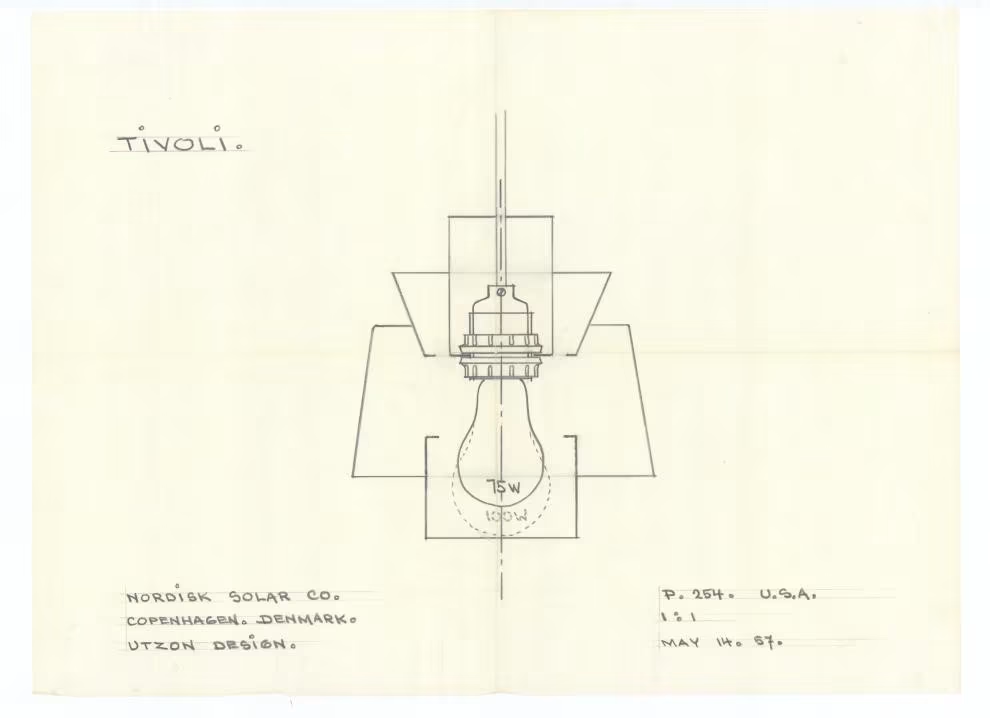
A sketch of Utzon's Tivoli light fitting
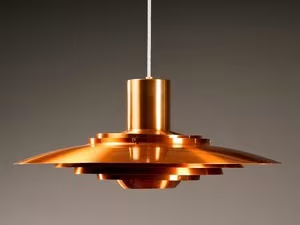
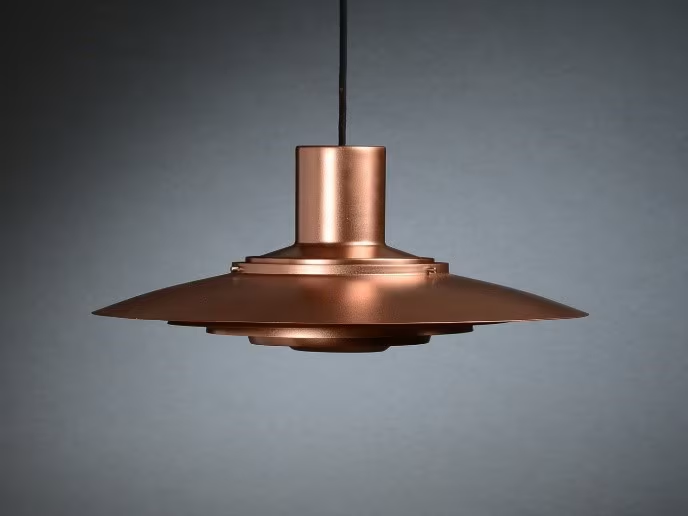
The Tivoli lamp quickly becomes a bestseller and young Harald Jørgensen is assigned the responsibility for developing the lighting production. However, only on the conditions that the production must be in Audiola and he can only adopt and produce light fittings which is suitable for export.
Harald Jørgensen knows that this will be a long-lasting assignment and he decides to focus on two areas:
1. Light knitting
With his organisation skills, he puts together a team of lighting experts and starts exploiting Audiola's existing assortment of bakelite sockets and other lighting materials. The project soon gets the name “Light knitting”.
Based on the philosophy that a socket is actually just a light fitting, the Light knitting project means that by the end of the day, warehouse employees are handed a cord, some sockets and fittings and are then asked to work on some fittings at home in the evening. At the same time, the lighting experts are tasked with selecting and procuring glass and metal shades.
An exciting assortment is put together. The Swedish glass manufacturer Flygfors supplies multi-coloured glass and the metal shades come from the company Domus, which is owned by one of Harald’s dear friends.
The lighting assortment becomes a great success at the Hannover fair, where Nordisk Solar Compagni participates for the first time in 1956. They enter agent and export agreement with new partners in the U.S., Canada and Japan.
2. Acknowledged architects and designers
Meanwhile, Harald Jørgensen is dedicated to expand the co-operation with esteemed architects and designers. The goal is clear. To repeat the success with Utzon and the Tivoli lamp.Harald Jørgensen is aware that if Nordisk Solar is to be associated with lighting design icons in the future, then he needs to go for quality and be careful when finding the leading architects and designers.
After a few years, he has succeeded in getting Jørn Utzon, Acton Bjørn, Sigvard Barnadotte, Max Brüel and Jørgen Høj to join in. Furthermore, he permanently employs Sven Middelboe as Solar’s own architect.In 1957, Nordisk Solar Compagni publishes the first ”Solar Fittings – Lighting catalogue”, which shows that the co-operation was very fruitful. The classy light fittings are illustrated uniformly and minimalistic. Under each illustration, the name of the designer is listed. There is a massive demand for the exclusive lamps. Sales expand and are quickly adopted in the export markets. Harald Jørgensen can be proud of himself.
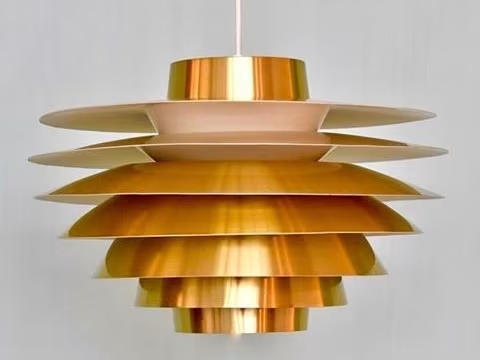

Video
The video portrays images from the Solar catalogue of designer lamps as well as the production facilities.
Get a feel of the 80s and enjoy a glimpse of the lighting production that made up a big part of Solar in that period of time.
Here, we follow the production of a design classic right from the first drawings on a computer, to seeing the finished product in an office.
Thus, the foundation is firmly in place and carries Solar’s development within lighting for the next 40 years until production is divested in 1998. The headlines and meaningful events from this journey are as follows:
1964: A factory for Audiola’s lighting production is established in Glostrup. A total of 900 people are employed in the two factories in Kolding and Glostrup.
1968: After the death of his father, Harald Jørgensen takes over the position as Chaiman of the Board in Audiola. The lighting production is extracted from Audiola and carries on as an independent department under the name “Solar Fittings Production” in Nordisk Solar Compagni. Solar lighting displays are established at every branch office.
1972: All activities of the production company Audiola moves to a newly established factory in Vejen, Denmark.
1979: The lighting production in Glostrup moves to Vejen. The production activities in Audiola and Solar Fittings are combined and consequently managed from hereon in Solar Fitting Production.
1986: Solar Fitting production establishes the company Solar Lighting in Norway.
1990: Solar acquires the Swedish lighting company Hans-Agne Jacobsson AB.
1992: The Solar Group’s two lighting companies merge in Hans-Agne Jacobsson, in Vejen. The company focuses on industrial lighting and outdoor lighting for infrastructure.
1998: The Solar Group sells the company Hans-Agne Jacobsson to Thorn Light in England.
Subsequently, Solar still handles lighting, but now via the Solar Light concept, which is based on procured products from leading European lighting manufacturers.
CV – Jacob Jørgensen, Kolding 1967
Personal data
Name Jacob Lauritz Jørgensen Date of birth Born 17 January 1891, Danish citizen Place of birth Sønderborg, which at the time belonged under Germany Civil status Married in 1918 to Marie Andersen, Vamdrup Children Harald Preben Jørgensen (06.01.1918) and Edith Jørgensen (20.01.1920) Address Strandvejen 9 in Kolding
Education and professional experience
1905 – 1906 Ship’s boy at the German school ship Potosi 1906 – 1909 Trains to be a ship constructing architect at shipyards in Flensburg and Eutin, Germany 1909 – 1910 Employed with Blom & Vos, Hamburg, and a power station in Hamburg 1910 – 1912 Employed as a sales representative and metrology expert with Solar Zähler Werke, Hamburg 01.02.1912 Immigrates to Denmark and represents the English company Solar Works 21.07.1913 Founder and manager of Solar Elektricitetsmaaleren v/ Pedersen & Jørgensen 17.05.1919 Founder and day-to-day manager of Nordisk Solar Compagni, Jernbanegade 19, Kolding 1919 - 1920 Receives trade licenses as merchant and manufacturer in Kolding 01.12.1924 Establishes the company Dansk Målerværksted, Kolding 1926 - 1928 Chairman of the business network Kolding Fodsportsforening af 1915 1927 - 1943 Honorary Consul to Germany in Kolding 1929 - 1933 Member of the board of Kolding Sejlklub (yacht club) 1930 Managing Director of Aktieselskabet Nordisk Solar Compagni, Kolding 1931 - 1946 Managing Director and Chairman of the board of Scandinavian Incandescent Lamp Factory in Kolding 1934 - 1938 Chairman of the board of A/S Kolding Ridehus (riding hall) at Dyrhavevej in Kolding 1938 Managing Director of Audiola Radio, Kolding 1960 Managing Director of Jacob L Jørgensen Holding Co 1961 Founder and owner of the shipping company Jørg Line 16.05.1967 Passed away after a short period of illness
Personal interests and qualifications
Interests Family, horses and riding, ships and yachting Languages Mastered Danish (with an accent), German and English in writing and speech Merchant Had a distinct sense for great business acumen, was innovative and an initiator